- fssai
- nutrition-labels
- exports
- food labelling
- compliance
Supplement Facts vs Nutrition Facts: The Compliance Guide
Understand the regulatory differences between Supplement Facts and Nutrition Facts to ensure your food or beverage brand stays compliant with FDA standards.
FCOS Team20 min read
Classifying a functional food as a dietary supplement is a strategic liability that most brands should avoid, regardless of their ingredient list. While the flexibility to make structure/function claims is tempting, the regulatory overhead and the 30-day FDA notification window often create a bottleneck that slows down product iteration. Forcing a beverage or snack into the supplement category simply to highlight a specific botanical often complicates the labeling process without providing a proportional increase in consumer trust or market share.
If you are a founder navigating your first production run, you likely view the choice between "supplement facts vs nutrition facts" as a binary hurdle to clear for retail entry. However, if you are a compliance lead at an agency managing a portfolio of CPG brands, the distinction between these two panels is the difference between a seamless multi-market launch and a three-month delay caused by misaligned "intended use" claims. The path you choose dictates your entire legal framework, from how you list ingredients to how you report allergens and calculate Daily Values.
This guide settles the debate by defining the regulatory fork in the road and providing the technical criteria required to satisfy 21 CFR 101.36. You will determine how to align your product's marketing intent with the FDA’s specific formatting mandates and how to centralize your data to avoid labeling drift. By the end of this analysis, you will have a clear framework for selecting the panel that maximizes your market speed while maintaining absolute compliance across different regulatory landscapes.
Key takeaways
- Choose Nutrition Facts for products consumed as conventional food or for taste, and Supplement Facts for products intended to supplement the diet.
- Structure/function claims on supplements require FDA notification within 30 days, whereas food claims are more strictly limited to established health benefits.
- Centralize your labeling data in a B2B workspace like FCOS to manage the distinct formatting requirements of 21 CFR 101.36 and other global standards.
- Use Supplement Facts when you need to list ingredients without established Daily Values, which are prohibited on standard Nutrition Facts panels.
Table of contents
- The regulatory fork in the road for food and beverage brands
- Positioning determines your labeling obligations
- Compare the core technical requirements
- Master the design constraints of 21 CFR 101.36
- Navigate the 30-day window for structure/function claims
- Account for allergen labeling across formats
- Interpret Daily Values for consumer clarity
- Centralize multi-market data to avoid labeling drift
- Verdict: When the choice is close enough to not matter
- Accelerate your launch with compliant PDF exports
- Frequently asked questions
- Selecting Your Regulatory Framework
The regulatory fork in the road for food and beverage brands
Deciding whether a product is a conventional food or a dietary supplement is the most consequential choice in the development lifecycle. This classification is not a matter of marketing preference; it is a fundamental regulatory pivot that dictates which federal statutes apply to the formulation, manufacturing, and advertising of the product. The Nutrition Facts Panel was first introduced in the early 1990s to provide consumers with standardized information, but the modern landscape has evolved into a strict binary system.
Choosing the "food" path requires compliance with the Nutrition Labeling and Education Act (NLEA). This framework focuses on caloric value, macro-nutrients, and ingredients generally recognized as safe (GRAS). Conversely, the "supplement" path falls under the Dietary Supplement Health and Education Act (DSHEA), which allows for the inclusion of certain botanical and bioactive ingredients that are prohibited in conventional foods.
The chosen path defines the brand’s entire legal framework and market speed. A product classified as a food must meet different safety standards for additives than a product classified as a supplement. Misclassification can lead to warning letters, product seizures, or mandatory reformulations, all of which halt commercial momentum. For companies navigating these technical requirements, utilizing Nutrition label software for food & beverage brands ensures that the data presented on the final panel aligns with the specific regulatory path chosen.
Ultimately, this decision affects how quickly a product can reach the shelf and what claims can be made once it arrives. While food labels focus on the provision of nutrients for daily diet, supplement labels are designed to highlight specific dietary ingredients intended to supplement the diet. Manufacturers must finalize this classification before beginning the design of the packaging or the finalization of the ingredient list.
Positioning determines your labeling obligations
The choice between a Supplement Facts panel and a Nutrition Facts panel is dictated by the product's "intended use" rather than its physical form or ingredient list. Regulatory bodies determine classification based on how a product is represented to the consumer. If a liquid product is marketed as a beverage for thirst-quenching, refreshment, or taste, it must carry a Nutrition Facts label. Conversely, if that same liquid is marketed to supplement the diet or address a specific nutrient deficiency, it falls under the dietary supplement category and requires a Supplement Facts panel.
Marketing claims, product names, and packaging design all contribute to this regulatory classification. A product sold in a 20-ounce bottle intended to be consumed in one sitting is rarely classified as a supplement, as supplements are typically consumed in small, measured quantities. If the branding emphasizes hydration and flavor over therapeutic or nutritional supplementation, the FDA generally mandates the Nutrition Facts format. Manufacturers must ensure their marketing copy does not contradict the labeling format chosen, as inconsistent positioning can trigger regulatory enforcement.
Compliance requires strict adherence to labeling laws regardless of the category. For instance, according to this guide on how to read dietary supplement labels, the Food Allergen Labeling and Consumer Protection Act was enacted in 2004, imposing specific disclosure requirements on both food and supplement manufacturers.
Deciding how to position a product requires analyzing target markets and local regulations. Manufacturers managing portfolios across different regions use FCOS to centralize these compliance decisions. For those needing to verify specific nutrition label requirements by market, the platform provides a structured framework to ensure that the chosen positioning aligns with the legal requirements of the destination country. This prevents the costly error of labeling a product as a supplement in a jurisdiction where its formulation or marketing would legally classify it as a conventional food.
Compare the core technical requirements
Determine whether your product is a food or a dietary supplement before designing your label. The FDA mandates specific formats for each category. Review the FDA's website for the 5 major differences between supplement facts panels and nutrition facts panels to ensure your ingredient disclosures and nutritional values meet regulatory standards.
Address mandatory nutrient declarations first. List every required nutrient on a Nutrition Facts panel, including total fat, saturated fat, cholesterol, sodium, and total carbohydrates. You must include these even if the amounts are zero or insignificant. When formatting a Supplement Facts panel, list only the dietary ingredients actually present in the formulation. Omit any nutrients not found in the supplement to ensure the label focuses on active ingredients.
Manage ingredients without established Daily Values (DV) according to the specific panel type. Use Nutrition Facts panels only for substances that have established DVs or Recommended Daily Intakes (RDI). If your product contains botanicals, amino acids, or herbs without an established DV, use a Supplement Facts panel. List these "other dietary ingredients" below the mandatory nutrients and include a symbol that points to a footnote stating "Daily Value not established."
Follow the correct rules for ingredient placement. List all ingredients in descending order of predominance by weight outside and below the panel for standard food labeling. For supplement labeling, you may choose to list dietary ingredients either within the Supplement Facts panel itself or in a separate list directly below it.
Provide the required level of detail for the source of each ingredient. Use granular detail for dietary ingredients on supplement labels. If you use a plant-derived ingredient, you must specify the part of the plant used, such as the root, leaf, or stem. You do not need this botanical specificity for conventional food Nutrition Facts panels.
Measure the quantity per serving using the appropriate metric for your product type. Focus on the amount of a nutrient relative to a standard serving size for food consumption when creating Nutrition Facts labels. For Supplement Facts labels, prioritize the specific weight of the dietary ingredient per serving unit, such as a capsule, tablet, or scoop, to highlight the potency of the active component.
Master the design constraints of 21 CFR 101.36
Follow the formatting standards established by the FDA to ensure dietary supplement compliance. You must control every design element governed by 21 CFR 101.36, including the weight of rules, text kerning, and leading. Use a "heavy bar" to separate dietary ingredients from vitamins and minerals. You must also list the "percent Daily Value" in a column on the right-hand side, even for ingredients where no Daily Value has been established.
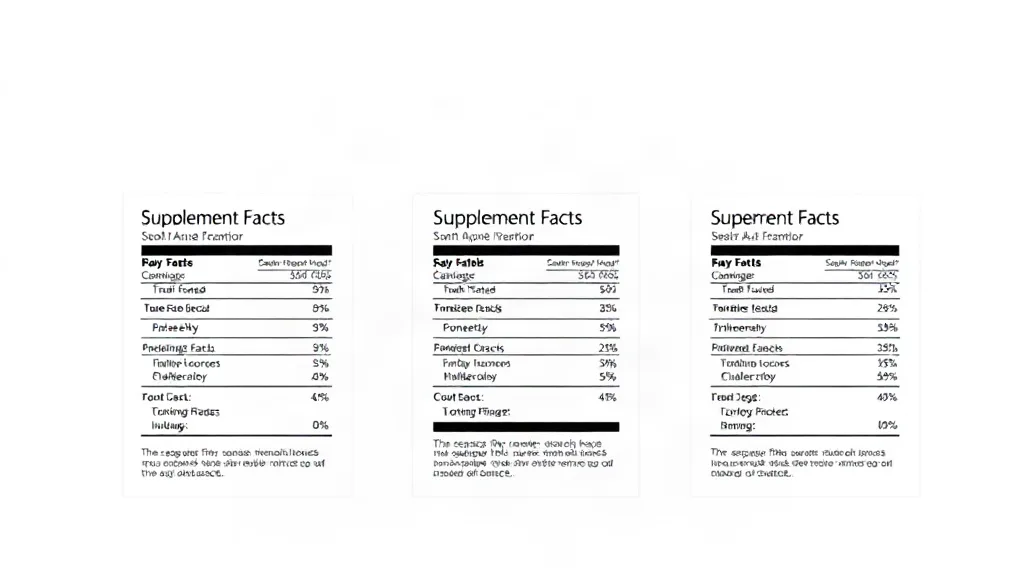
Review the technical requirements in 21 CFR 101.36 to manage the complexity of these layouts. You must set the "Supplement Facts" heading to at least 8-point type and enclose all information within a box. Precise adherence to these specifications is necessary to avoid misbranding charges. Accurate nutritional data will not protect a manufacturer if the physical label fails to meet these hairline specifications.
Bold the "Servings Per Container" and "Serving Size" fields and place a horizontal line between every listed ingredient. When labeling a proprietary blend, identify the total weight of the blend. You do not need to disclose the individual weights of the constituents, but you must list them in descending order of predominance by weight.
Use automated label builders like FCOS to translate formulation data into compliant graphics and avoid the errors common in manual design. These systems adjust spacing and font weights automatically to meet federal standards, reducing the risk of regulatory rejection. If you lose access to these tools during production, reset your FCOS password immediately to maintain legal labeling processes. Software that incorporates the nuances of 21 CFR 101.36 helps you avoid the formatting mistakes that lead to FDA warning letters.
Navigate the 30-day window for structure/function claims
Manufacturers using Supplement Facts panels often rely on structure/function claims to communicate the product's benefits, such as "supports joint health" or "promotes immune function." While these claims do not require pre-approval by the FDA in the same manner as drug claims, they carry a strict post-market notification requirement. A manufacturer must submit notification to the FDA that a structure/function claim is truthful and not misleading within 30 days of first marketing the dietary supplement.
This 30-day window creates a high-stakes compliance environment for teams operating at launch speed. Because the notification occurs after the product has already entered distribution, any failure to substantiate the claim or meet the filing deadline can result in regulatory intervention, including warning letters or product recalls. The burden of proof rests entirely on the brand to ensure that the wording on the label aligns with competent and reliable scientific evidence at the moment of sale.
Compliance teams must synchronize their marketing timelines with their regulatory filings to avoid missing this window. Detailed records of the substantiation for each claim should be finalized before the product reaches the consumer. For professionals managing these complex workflows, utilizing specialized tools can reduce the risk of oversight. About FCOS: nutrition label software for food teams provides resources for maintaining data integrity during the transition from formulation to final labeling.
Under the Dietary Supplement Health and Education Act (DSHEA), the notification must also include the mandatory disclaimer stating that the FDA has not evaluated the claim and that the product is not intended to "diagnose, treat, cure, or prevent any disease." Ensuring that the notification of dietary supplement claims is filed accurately and on time is a critical step in maintaining the legal status of a supplement on the market. Failure to navigate this period correctly transforms a compliant supplement label into a misbranded product.
Account for allergen labeling across formats
Apply the same allergen disclosure standards to your product whether you use a Nutrition Facts panel or a Supplement Facts panel. Ensure transparency regarding major food allergens to meet mandatory FDA requirements for all packaged foods and dietary supplements under the Food Allergen Labeling and Consumer Protection Act of 2004.
Identify all "major food allergens," including milk, eggs, fish, crustacean shellfish, tree nuts, wheat, peanuts, soybeans, and sesame. Declare these allergens using one of two methods for either labeling format:
- Within the Ingredient List: Place the common or usual name of the allergen in the ingredient statement. Follow this with the food source in parentheses. Examples include "lecithin (soy)" or "whey (milk)."
- A "Contains" Statement: Add a separate line immediately following or adjacent to the ingredient list. Start this line with the word "Contains," followed by the name of the food source from which the allergen is derived. An example is "Contains: Milk, Soy."
Position the allergen declaration below the "Other Ingredients" list when using a Supplement Facts panel. If you use a Nutrition Facts panel, place the disclosure immediately after the standard ingredient list.
Avoid regulatory action and product recalls by ensuring full disclosure. Verify that you identify the specific species for fish, such as cod or tuna, and for crustacean shellfish, such as shrimp or crab. You must also name the specific type of nut for tree nuts, such as almonds or pecans. Maintain this level of specificity across both "supplement facts vs nutrition facts" formats to protect consumers and secure your regulatory standing.
Interpret Daily Values for consumer clarity
To provide consumers with a clear understanding of a product’s nutritional impact, brands must accurately calculate and present the Percent Daily Value (%DV). This figure represents how much a nutrient in a single serving contributes to a total daily diet. For both Nutrition Facts and Supplement Facts panels, these percentages are calculated based on a standard 2,000-calorie daily diet. While individual caloric requirements vary, this baseline ensures a uniform metric for comparison across the marketplace.
Determining whether a product’s nutrient profile is "high" or "low" is governed by specific percentage thresholds. A nutrient level of 5% DV or less per serving is considered low. Conversely, a level of 20% DV or more is considered high. Understanding these benchmarks is critical when deciding which labeling format best serves the product’s marketing and regulatory goals.
If a product contains vitamins or minerals at levels significantly exceeding 100% of the DV, the Supplement Facts panel is often the more appropriate choice. This format is designed to handle high-potency ingredients and allows for the listing of dietary components that do not have an established Daily Value, such as proprietary herbal blends. In contrast, if a product provides nutrients at "low" or moderate levels as part of a standard food or beverage, the Nutrition Facts panel is the required format.
Choosing the correct panel based on these values prevents consumer confusion and ensures the product is categorized correctly by regulators. As noted in an article published June 5, 2025, the distinction between these two formats relies heavily on how the nutrient density is framed relative to daily requirements. Brands should audit their formulations against the 5% and 20% thresholds to determine if their product functions as a supplemental boost or a dietary staple.
Centralize multi-market data to avoid labeling drift
Eliminate labeling drift by unifying your ingredient data across all markets. When teams maintain separate spreadsheets for US Supplement Facts and EU or GCC Nutrition Facts, the same formulation often ends up with inconsistent nutritional values. This occurs because domestic updates frequently fail to sync with international counterparts, or teams misapply region-specific rounding rules to raw data.
Centralize raw ingredient data in a unified digital repository to eliminate these discrepancies. Store raw concentration levels, allergen profiles, and botanical extracts in a master database rather than relying on finished label images or static PDFs. When a product moves from a US Supplement Facts format, where specific bioactive compounds may be highlighted, to a region where it must be sold as a standard food, the central system generates the required Nutrition Facts panel based on that region’s specific legal requirements.
Focus on these transitions if you manage products in the US, EU, and Middle East simultaneously. While the US allows for significant distinction between supplements and food, other jurisdictions have stricter thresholds for what constitutes a supplement. For example, a product marketed as a dietary supplement in the US might be categorized as a fortified food in the Gulf region, necessitating a complete shift in formatting and mandatory nutrients. Professionals managing these transitions should consult specific GCC nutrition label requirements (GSO) + label builder resources to ensure the data mapping aligns with the latest GSO standards.
Automate unit conversions from a central data point to prevent manual calculation errors. Converting International Units (IU) to micrograms (mcg) or milligrams (mg) for different regulatory bodies is a common failure point. By automating these conversions, you minimize the risk of a compliance rejection during a port inspection or a retail audit.
Use a centralized platform to manage Daily Values (DV) or Reference Intakes (RI) instead of tracking them on a label-by-label basis. Because these percentages vary by region, manual tracking often leads to outdated information. Store the raw ingredient volume and allow the system to apply the current regional percentage to ensure every label is compliant with the most recent local health authority guidelines. This architecture ensures that if a raw material specification changes at the source, that change propagates to every regional label version simultaneously, maintaining total compliance across the product portfolio.
Verdict: When the choice is close enough to not matter
Select a labeling format based on your marketing goals and regulatory capacity when a product sits on the border between conventional foods and dietary supplements. This flexibility applies to items such as functional waters, protein bars, or energy shots. When the ingredients and intended use qualify as both a food and a supplement, the decision rests on how you intend to position the product rather than a strict legal mandate.
Use the Nutrition Facts panel for products designed for general hydration or meal replacement. This format signals to the consumer that the item is a food intended for regular consumption. Choose the Supplement Facts panel if your marketing highlights a concentrated active ingredient or a specific physiological benefit. While both formats require accuracy, they involve different rules for layout, font size, and ingredient listing.
Quality assurance teams should use this 1-minute summary of the differences between supplement facts and nutrition facts to determine which path fits the specific formulation.
Check the regulatory status of your ingredients before finalizing the label. If a product includes "non-dietary" ingredients that lack approval as food additives or "Generally Recognized as Safe" (GRAS) status for food use, you must use the Supplement Facts format. If all ingredients are food-grade, choose the format that matches your brand identity. Lifestyle foods face stricter regulations regarding serving sizes. Targeted health tools involve specific FDA notification requirements for any structure or function claims.
Accelerate your launch with compliant PDF exports
Transitioning from a finalized formulation to a shelf-ready label requires precision to avoid costly print errors or regulatory delays. To maintain launch speed, companies must automate the conversion of raw ingredient data into formatted PDF exports. FCOS serves as the central bridge in this process, pulling directly from the product’s bill of materials to generate either Supplement Facts or Nutrition Facts panels based on the selected regulatory framework.

By utilizing a centralized system, teams eliminate the manual transcription risks inherent in spreadsheets. FCOS adjusts font sizes, leading, bolding requirements, and daily value percentages automatically to meet FDA or international standards. This functionality allows brands to toggle between formats as product classifications or target markets shift, ensuring that the final PDF is ready for immediate integration into packaging design.
Users can select from various subscription tiers to access advanced export features and multi-region compliance tools. Stakeholders should verify specific plan inclusions and current pricing on the vendor’s official pricing page to ensure the selected tier supports their necessary output volume and jurisdictional needs. Centralizing this workflow ensures that the transition from R&D to the retail shelf is governed by data integrity rather than manual entry.
Frequently asked questions
Why does the FDA not approve supplements?
The FDA does not have the legal authority to approve dietary supplements for safety or effectiveness before they are marketed to the public. Under the Dietary Supplement Health and Education Act of 1994 (DSHEA), the responsibility for ensuring product safety and labeling accuracy rests entirely with the manufacturer. The agency’s role is limited to post-market surveillance, where it monitors adverse event reports and takes action against products proven to be adulterated or misbranded.
Is it better to get your nutrients from food or supplements?
Whole foods are the preferred source of nutrients because they offer a complex matrix of fiber, antioxidants, and synergistic phytonutrients that isolated supplements cannot replicate. While supplements fill specific micronutrient gaps identified through clinical testing, they are regulated as additions to the diet rather than replacements. If your product is intended to provide a significant source of calories or is consumed for taste and satiety, it must utilize a Nutrition Facts panel rather than a Supplement Facts panel.
Why do doctors discourage supplements?
Medical professionals often discourage supplement use due to the lack of mandatory pre-market clinical trials and the potential for dangerous interactions with prescription medications. There is also a significant risk of "over-supplementation," where consumers exceed the Tolerable Upper Intake Levels (UL) for fat-soluble vitamins, leading to systemic toxicity. Doctors prioritize standardized pharmaceutical interventions where purity, dosage, and metabolic pathways are strictly controlled and verified.
What two supplements should never be taken together?
Calcium and iron should not be ingested at the same time because they compete for the same receptors in the digestive tract, significantly inhibiting iron absorption. To maintain the efficacy of both minerals, consumers should space these doses by at least two hours. Manufacturers should consider these contraindications when formulating multi-ingredient products or providing usage instructions on the Supplement Facts label to ensure consumers receive the intended physiological benefit.
Selecting Your Regulatory Framework
You must now decide whether your product enters the market as a conventional food or a dietary supplement, a choice that dictates your formulation limits, labeling layout, and marketing claims.
- Analyze intended use. Determine if the product is primarily consumed for taste and satiety or specifically to supplement the diet.
- Audit ingredient status. Verify if your formula contains ingredients not generally recognized as safe (GRAS) that require a New Dietary Ingredient (NDI) notification.
- Evaluate claim requirements. Assess whether your marketing strategy relies on structure/function claims that necessitate a 30-day FDA notification.
- Confirm physical format. Check if your delivery method, such as a capsule, powder, or liquid, aligns with the regulatory definitions of your chosen category.
- Review manufacturing standards. Ensure your production facility is prepared to meet the specific cGMP requirements for either 21 CFR 111 or 21 CFR 117.
Use FCOS to centralize your ingredient data and generate compliant labels for both formats instantly. Visit https://fcos.cloud/ to streamline your regulatory workflow and eliminate labeling drift.