P / 1
The market changes, but the product record stays the same.
Add Europe (EU) as a market target without copying values into another spreadsheet or rebuilding the SKU from scratch.
Europe (EU)
The EU's Food Information to Consumers regulation standardizes the nutrition declaration across member states. Here is the format your EU-bound packs need.
Market setup
Market guide
This guide is written for product, operations, QA, and regulatory teams who need the practical shape of a Europe (EU) nutrition label.
Regulation (EU) No 1169/2011 on Food Information to Consumers (FIC) makes a nutrition declaration mandatory on most prepacked foods across the EU. The mandatory declaration, per 100 g or 100 ml, covers:
Per-portion values may be added voluntarily. Vitamins and minerals can be declared when present in significant amounts.
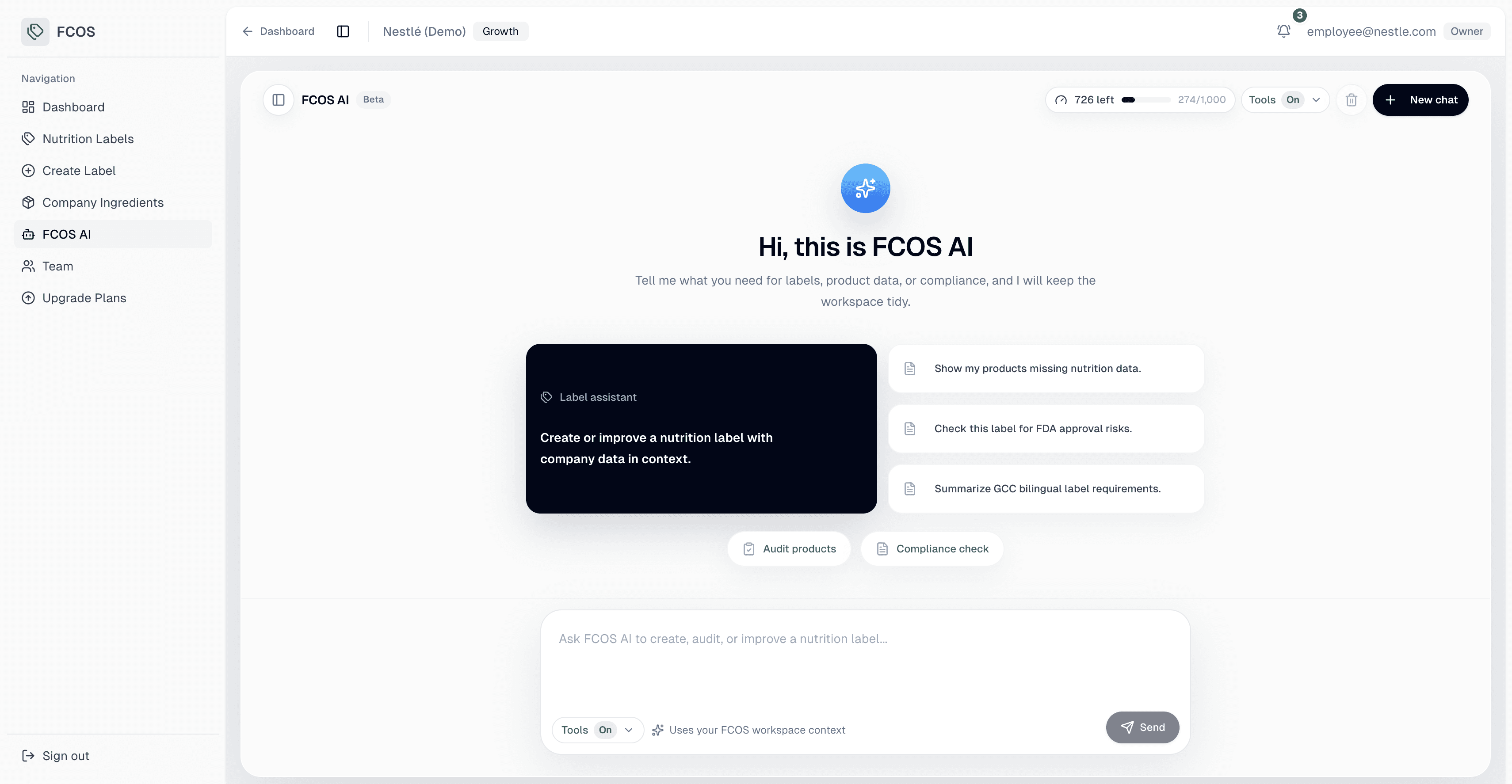
Choose Europe as a market in FCOS to generate an EU-style nutrition declaration from the same product data you use for your other markets, with team review and PDF export built in.
This overview is general guidance, not legal advice. Final compliance always depends on your product and jurisdiction — confirm requirements with your regulatory counsel.
Built into FCOS
Enter ingredients, nutrition values, serving details, and the markets the SKU will sell in.
FCOS uses the same product data to shape the label around the selected market format.
Keep reviewers in the loop, then export the approved label PDF for your team or partner.
Where it pays off
P / 1
Add Europe (EU) as a market target without copying values into another spreadsheet or rebuilding the SKU from scratch.
P / 2
Editors prepare the label, reviewers approve the version, and the exported file reflects the version that passed review.
P / 3
Share a shelf-ready PDF generated from structured product data instead of screenshots, emails, or disconnected drafts.
Stack comparison
Learn more
Yes. Regulation (EU) 1169/2011 makes the nutrition declaration mandatory on most prepacked foods, expressed per 100 g or 100 ml.
Salt. The EU declaration lists salt (sodium × 2.5), unlike the US label which declares sodium.
Allergens are emphasised within the ingredient list itself — typically in bold — rather than in a separate allergen box.
Keep exploring
Selling packaged food in India means complying with FSSAI's Labelling and Display Regulations. Here is what your nutrition label needs, and how FCOS helps you ship it.
Food sold across the Gulf Cooperation Council follows GSO technical regulations, including bilingual Arabic labelling. Here is the short version for product teams.
The UAE follows GCC (GSO) labelling standards with national oversight. Here is what food brands need on pack to sell in the Emirates.
Try the FCOS label builder free. Pick Europe (EU) as the market and see the label take shape from structured nutrition data.