
- fssai
- nutrition-labels
- exports
- food labelling
- compliance
Mastering Healthcare Information Management for Food Brands
Learn how healthcare information management principles ensure food label compliance and consumer safety across international markets like the FDA and EU.
FCOS Team19 min read
A nutrition label is a clinical document, not a marketing asset. While branding teams often view the back-of-pack as a design hurdle or a legal obligation, treating nutrition data as anything less than healthcare information management is a liability that invites regulatory intervention. If you view your ingredient list as static text rather than a dynamic data set that dictates consumer physiology, you are operating with a fundamental misunderstanding of the risks inherent in the modern food supply chain.
The path you take to rectify this depends entirely on your scale and your stakes. A solo founder validating a single product for a domestic launch faces a different set of risks than a regulatory agency managing a portfolio of three hundred SKUs across multiple continents. For the founder, the challenge is establishing a "source of truth" before data drift makes their spreadsheets unmanageable; for the agency, the challenge is maintaining clinical-grade accuracy while delivering at the speed their clients demand.
This article settles the decision between maintaining manual, siloed records and adopting a centralized healthcare information management framework. It provides the technical logic required to move beyond disconnected spreadsheets and into a system where every nutrient value is traceable, every regional rounding rule is automated, and every label export is a verified output of a controlled data environment.
Key takeaways
- Treat nutrition data as clinical-grade information to prevent regulatory recalls and health risks.
- Centralize data sources to eliminate the 'version control' errors that plague multi-market CPG brands.
- Adopt automated validation workflows to bridge the gap between raw lab results and market-specific label requirements.
- Audit the data lineage from supplier COAs to the final PDF export to ensure total traceability.
Table of contents
- Healthcare information management ensures data integrity for consumer safety
- Nutrition data is clinical information in a consumer wrapper
- Centralize the source of truth to prevent data drift
- Map raw lab results to regional regulatory schemas
- Automate the transition from data to PDF export
- Audit the lineage of every nutrient value
- Standardize team reviews to eliminate compliance bottlenecks
- Validate labels at launch speed without account friction
- Bridge the gap between FSSAI and FDA requirements
- Evaluate the cost of information mismanagement
- Frequently asked questions
- What is the difference between health information management and food data compliance?
- How does healthcare information management impact food labeling regulations?
- Why do CPG brands need a central source of truth for nutrition data?
- What are the risks of manual data entry in international food labeling?
- The Choice Between Clinical Rigor and Compliance Risk
Healthcare information management ensures data integrity for consumer safety
Organize and protect health-related data systematically to ensure it remains accurate and accessible. For food brands, this discipline requires managing nutritional profiles, allergen declarations, and ingredient specifications as clinical-grade data. The primary objective is to maintain a unified master record that stays consistent from the laboratory to the consumer’s digital interface.

Use rigorous data governance to achieve this level of accuracy. Establish a centralized framework where every data point, such as a vitamin percentage or a sodium count, is validated against standardized protocols. Implement automated validation rules to prevent conflicting information from entering the system. This ensures that when a product formulation changes, the update propagates through all consumer-facing channels simultaneously, which maintains the integrity of the health information provided to the public.
Avoid systemic failures in data integrity by eliminating data silos and manual transcription. When different departments, including R&D, compliance, and marketing, maintain their own versions of product data, the risk of discrepancy increases. Stop manual transcription because a single keystroke error during the transfer of data from a supplier specification sheet to a marketing label can result in a life-threatening allergen omission or an incorrect carbohydrate count for a diabetic consumer.
Replace disconnected spreadsheets immediately if they are used to manage nutrition facts. Spreadsheets lack the version control, audit trails, and automated checks necessary for healthcare-grade data management. Transition to a proactive safety model by moving toward integrated platforms like FCOS.cloud. By utilizing a centralized system designed for high-stakes information management, companies eliminate the risks inherent in manual data handling and ensure that consumer safety is never compromised by administrative fragmentation.
Nutrition data is clinical information in a consumer wrapper
Treat product specifications and nutrition panels as clinical data sets instead of static marketing assets. Although packaging design drives sales, the printed data functions as a set of physiological instructions. Consumers who read labels to manage metabolic conditions or avoid life-threatening reactions are performing healthcare information management. Data accuracy is a critical health requirement rather than a simple regulatory compliance task.
For individuals managing chronic illnesses like type 2 diabetes or cardiovascular disease, macronutrient values are variables in a daily medical calculation. These values, specifically carbohydrates, sugars, and sodium, must be precise. Any error in these figures can cause hyperglycemic episodes or long-term health mismanagement. Allergen declarations carry even greater risk. Inaccurate data regarding gluten, nuts, or dairy is a failure of patient safety that can lead to immediate anaphylaxis. It is never a mere labeling technicality.
Apply the same rigor to nutrition data that you would apply to medical records to ensure your brand remains a safe participant in the consumer's health ecosystem. Move beyond basic compliance checklists and implement a robust framework that prioritizes data integrity. Professionals who need to understand how these responsibilities intersect with modern commerce should consult the guide on Navigating the Healthcare Marketplace for Food Brands.
Align internal processes with the needs of health-conscious consumers by treating food products as biological inputs. FCOS.cloud supports this alignment by managing product data as a dynamic, high-stakes asset. When you remove the distinction between consumer information and clinical information, absolute data accuracy becomes your primary operational driver.
Centralize the source of truth to prevent data drift
Prevent data drift by consolidating all nutritional profiles, allergen declarations, and ingredient lists into one shared workspace. Data drift occurs when product information diverges across different files, departments, and regional offices. In a typical multi-market food brand, information often moves from a formulation spreadsheet to a quality assurance PDF before reaching a localized regulatory filing. If a developer removes an allergen from a formulation but the regulatory team uses data saved three weeks prior, the brand becomes non-compliant.
Avoid using traditional healthcare information management systems that fragment data by department or geography. These systems function as archives rather than active workspaces. They rely on manual file transfers, which increases the likelihood of mistakes. When you copy data between environments, you sever the link to the original source. Any subsequent update to the master product specification will not reach the rest of the chain. This leaves the brand vulnerable to mismatched labels and potential recalls.
Establish one environment where every stakeholder, including R&D and legal teams, interacts with the same live data set. FCOS.cloud provides this central workspace to prevent the departmental isolation that causes data drift. By maintaining a master record for each product, the platform ensures that a change made at the formulation level is immediately visible to every user, regardless of which market they manage. This removes the need to compare multiple versions of the same specification.
Ensure all relevant stakeholders have continuous access to the system to maintain this continuity. Users who cannot log in should immediately reset your FCOS password to regain access to the live data environment. This prevents staff from reverting to localized, offline spreadsheets.
Consolidate all product attributes into one environment to move away from checking files for mistakes after they occur. Instead of auditing disparate files to find discrepancies, teams work from a foundation where information is inherently consistent. This centralization is the prerequisite for all further regulatory work. It ensures that when you format data for specific regional requirements, you draw it from a verified and current source.
Map raw lab results to regional regulatory schemas
Convert laboratory Certificate of Analysis (CoA) data into consumer-facing labels by applying a transformation layer that follows regional legal definitions. Raw chemical analysis yields precise decimals, but these figures are often illegal to print directly on packaging. Process these figures through specific rounding algorithms and compare them against regional Daily Value (DV) or Reference Intake (RI) benchmarks.
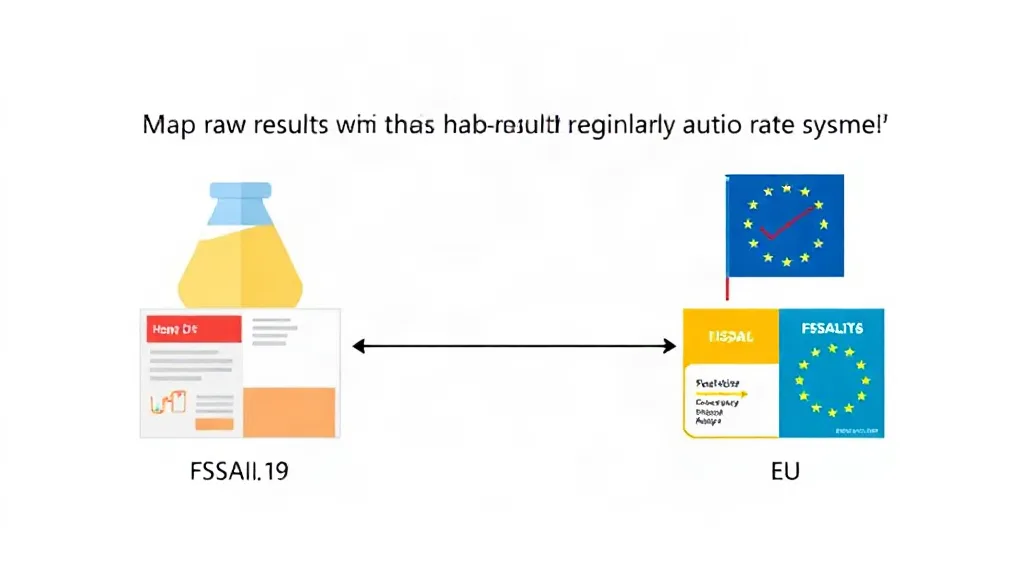
Avoid manual spreadsheets that require users to remember different rounding increments for each nutrient and target market. A fat content of 0.42g might be rounded to 0g in one jurisdiction, yet it must be declared as 0.5g or in milligrams in another. Manual entry leads to "rounding drift." This occurs when small errors in individual ingredient calculations compound into non-compliant totals on the final label.
Use automated software logic to eliminate this risk. FCOS.cloud applies pre-configured regulatory gates to the raw data. Select a specific market, and the system automatically translates the raw lab output into the correct format. This includes adjusting for mandatory unit conversions, such as switching between Calories and Kilojoules, and calculating the percentage of daily values based on the specific demographic requirements of the region. Centralize these rules to ensure that the same raw data point correctly populates a US FDA label, an EU 1169/2011 panel, and a GCC-compliant layout simultaneously.
| Regulatory Body | Rounding Logic | Mandatory Nutrients | Unit Requirements |
|---|---|---|---|
| USA (FDA) | Incremental (e.g., <0.5g rounds to 0; <5g rounds to 0.5g) | 15 core nutrients including Added Sugars, Vitamin D, and Potassium | Calories, g, mg, %DV |
| Europe (EU 1169/2011) | Threshold-based (e.g., <0.5g declared as 0g or "contains negligible amounts") | 7 core: Energy, Fat, Saturates, Carbohydrate, Sugars, Protein, Salt | kJ and kcal, g, %RI |
| Gulf (GCC) | Follows GSO standards; specific decimal precision for macro-nutrients | Similar to FDA; requires specific declaration of salt and fat types | Dual language (Arabic/English), g, mg |
| Australia (FSANZ) | Rounding to significant figures or specific decimal places per NIP guidelines | Energy, Protein, Fat, Saturated Fat, Carbohydrate, Sugars, Sodium | kJ, g, mg (Sodium is mandatory; Salt is not) |
Automate the transition from data to PDF export
Establish a direct pipeline between your digital database and final design files to move healthcare information management data into consumer-facing PDFs. Treat the label as a dynamic export of verified data rather than a static art project. This approach prioritizes data integrity and ensures that approved lab or regulatory specifications appear accurately on the retail shelf.
Pull nutrient values, allergen statements, and ingredient lists directly from a central repository into a templated layout. FCOS.cloud maps database fields to specific regions on the label artwork to eliminate manual copy-paste tasks. This removal of manual entry prevents the common CPG launch errors associated with human transcription. When a regulatory specialist updates a sodium value or fiber count in the database, the change propagates to the export template automatically to maintain a single version of truth.
Shift the "human-in-the-loop" role from data entry to high-level verification by removing manual input during the design phase. Stakeholders should review the rendered PDF against the source data within the platform to confirm the visual representation matches scientific specifications. Implement a structured Digital Workflow for Food Label Review Cycles to refine internal checkpoints and maintain speed without sacrificing accuracy.
Generate a high-resolution, print-ready PDF that contains all necessary healthcare information. This includes everything from the Nutrition Facts panel to the ingredient declarations, produced without a designer manually typing a single digit. This automation ensures that the healthcare information management principles applied at the data level remain preserved throughout the product packaging lifecycle.
Audit the lineage of every nutrient value
Maintain a transparent, unbreakable chain of evidence for every value printed on a label. Treat nutritional data as clinical-grade information rather than a marketing exercise, as healthcare providers and consumers rely on these figures for medical decisions. This traceability forms the functional backbone of healthcare information management.
Transition from static spreadsheets to a dynamic management platform to establish this lineage. You must be able to select any single data point, such as a 'Sugar' value of 15g, and trace it back through the product’s history. In a professional healthcare information management workflow, you link this value directly to the recipe formulation, which connects to the specific raw material specifications provided by suppliers.
Ensure the audit trail terminates at a primary source document, such as a specific supplier Certificate of Analysis (COA) or an independent laboratory test report. If an auditor or healthcare professional challenges label accuracy, produce the time-stamped document that justifies that specific grammage immediately. Using a centralized system like FCOS.cloud facilitates this by anchoring digital documents to specific nutrient fields, which keeps evidence accessible within a few clicks of the final output.
Use granular oversight to prevent "data drift" caused by manual copying across multiple systems. Configure your management platform to flag changes when a supplier updates a COA, allowing you to see exactly how that update ripples through the product line. Maintaining this lineage ensures healthcare information remains accurate, defensible, and safe for the end-user. Without a verifiable connection between the lab and the label, you are not managing information; you are merely hosting unverified claims.
Standardize team reviews to eliminate compliance bottlenecks
Efficiency in healthcare information management depends entirely on the synchronization of cross-functional teams. In many food brands, the review process is hampered by asynchronous communication, where regulatory officers, quality assurance leads, and product developers exchange static PDF attachments or spreadsheets via email. This creates version control risks, as one department may be approving a formulation while another is already iterating on a new version of the raw material specifications.

To eliminate these bottlenecks, brands must transition to a centralized review environment. Using FCOS.cloud, multi-market teams can access a single, live data source for every product. This ensures that a regulatory officer in one region and a product manager in another are looking at the exact same data set in real-time. When a change is proposed, it is visible to all stakeholders immediately, rather than being buried in a thread of conflicting attachments.
Standardizing the review process within a unified platform creates a definitive audit trail. Instead of searching through sent folders to prove when a specific health claim was vetted, teams can track the entire approval lifecycle within the system. This transparency reduces the time spent on internal reconciliation and prevents the "information silos" that lead to labeling errors.
For brands operating across different regulatory jurisdictions, this centralized approach is critical. It allows global teams to set baseline compliance standards while giving regional teams the ability to review specific local requirements against the master data. By moving the review process out of the inbox and into a structured management environment, organizations ensure that healthcare information remains consistent from the initial R&D phase through to final market release.
Validate labels at launch speed without account friction
Launching a food product requires immediate alignment with healthcare information management standards. Delays often stem from uncertainty regarding whether internal product data is structured correctly for regulatory scrutiny. To mitigate this, FCOS.cloud provides a diagnostic environment designed to eliminate the friction typically associated with systems integration. Founders and product managers can utilize the platform’s builder tool to map ingredient lists, nutritional panels, and allergen declarations against global benchmarks without initiating a full-scale software migration.
This diagnostic feature serves as a technical audit for a brand's current data maturity. By inputting existing specifications into the builder, a company can identify specific areas where their information management fails to meet international requirements. It acts as a sandbox to test data integrity, ensuring that labels are not only accurate but also formatted for the interoperability required by modern retail and healthcare databases.
The process bypasses the traditional barriers of long-term commitments or complex onboarding. It allows a brand to see exactly how their data translates into a compliant label format in real-time. To begin evaluating current data structures against these international standards, Create your FCOS company account and access the diagnostic builder. Users should confirm the specific features and limitations of the free experience on the FCOS website, as available tools and trial terms are subject to update.
This approach facilitates rapid label validation at launch speed. Instead of guessing if a label is compliant, founders receive a clear signal on whether their current healthcare information management practices are sufficient for their target market. By identifying data gaps early, brands avoid the high costs of corrective labeling and regulatory rejections that occur when data silos are left unaddressed until the final stages of a launch.
Bridge the gap between FSSAI and FDA requirements
Establish a single product record to serve as a versatile source of truth when expanding a food brand across international borders. This approach manages the structural divergence between the United States Food and Drug Administration (FDA) and the Food Safety and Standards Authority of India (FSSAI). You must ensure data can be dynamically re-formatted to meet the distinct healthcare information standards of each region without manual data re-entry.
Shift your data schema according to the specific market requirements. In the United States, the FDA focuses on Reference Amounts Customarily Consumed (RACC), requiring data formatted for serving sizes, added sugars, and Daily Value (DV) percentages based on a 2,000-calorie diet. For the Indian market, FSSAI regulations prioritize nutritional values per 100g or 100ml of the product. You must also include specific visual markers, such as the veg/non-veg logo, and calculate Recommended Dietary Allowance (RDA) percentages based on localized Indian dietary guidelines.
Move away from static label files and toward a centralized digital repository to bridge the gap between these regulations. This repository should store raw nutritional values, such as precise milligram counts for sodium or gram counts for proteins, independent of any specific regional format. Apply localized logic to this raw data through a robust management system. The system must automatically convert US imperial measurements into metric units and recalculate nutrient density for the Indian market. Utilize a resource covering FSSAI nutrition label requirements (India) + label builder to ensure every technical parameter aligns with current Indian law.
Centralize these records using a platform like FCOS.cloud to eliminate the risk of version-control errors. Ensure that while the presentation layer changes to satisfy different regulators, the underlying healthcare information remains synchronized and accurate across the entire global supply chain.
Evaluate the cost of information mismanagement
The financial burden of inadequate healthcare information management manifests most visibly through product recalls. Beyond the immediate logistical expense of reclaiming goods, a brand faces substantial legal fees and regulatory fines that can compound over years of litigation. In international trade, data discrepancies often result in the immediate suspension of market access, stalling revenue streams while competitors occupy the vacated shelf space. These are not merely administrative errors; they are existential threats to a food brand’s bottom line.

Contrast these liabilities with the operational stability provided by a dedicated B2B workspace. Utilizing FCOS.cloud to manage compliance documentation replaces manual, error-prone data entry with a synchronized system of record. This shift reduces the human hours required for audit preparation and significantly lowers the probability of a compliance failure. By delegating the heavy lifting of regulatory tracking to a specialized platform, brands secure their market position and avoid the compounding costs of corrective action. For specific plan details and current feature sets, users should confirm details on the FCOS.cloud website, as service offerings and pricing structures are subject to periodic updates.
Frequently asked questions
What is the difference between health information management and food data compliance?
Health information management (HIM) governs the lifecycle of clinical data, whereas food data compliance applies these same rigorous governance standards to nutritional and allergen values. While traditional HIM focuses on patient records, food brands utilize these principles to treat nutrition facts as clinical data that must remain immutable from the laboratory to the consumer. This methodology ensures that the "consumer wrapper" of a product accurately reflects the underlying scientific analysis.
How does healthcare information management impact food labeling regulations?
Healthcare information management provides the technical framework for the traceability and audit trails necessitated by modern FDA and FSSAI transparency mandates. By adopting HIM standards, brands can automate the verification of health claims and ingredient declarations against specific regional legal schemas. This systematic rigor ensures that every data point on a label is backed by a verifiable lineage, reducing the risk of regulatory rejection during cross-border expansion.
Why do CPG brands need a central source of truth for nutrition data?
A central source of truth prevents "data drift," a phenomenon where conflicting versions of a nutrient profile exist across R&D, marketing, and legal departments. Utilizing a dedicated platform like FCOS.cloud allows a brand to anchor its entire portfolio to a single validated dataset, ensuring that a change in a raw ingredient's lab result propagates to every digital and physical label instantly. This synchronization is the only way to maintain absolute consistency across thousands of SKUs in multiple jurisdictions.
What are the risks of manual data entry in international food labeling?
Manual data entry introduces high rates of human error that lead to mislabeled allergens, incorrect Daily Value (DV) calculations, and expensive product recalls. These risks are magnified in international trade, where data must be manually reformatted and converted to meet the distinct rounding rules and unit requirements of different sovereign regulators. Automating the transition from raw data to export-ready formats eliminates these friction points and secures the integrity of the brand’s clinical information.
The Choice Between Clinical Rigor and Compliance Risk
Before transitioning your nutrition data into a healthcare information management framework, answer these five questions to determine your organizational readiness:
- Audit current silos: Identify every point where raw laboratory results are manually transcribed into marketing spreadsheets or design files.
- Define regulatory scope: Map the specific regional schemas, such as FSSAI or FDA requirements, that your product must satisfy simultaneously to avoid cross-border friction.
- Assess version control: Determine how many disparate versions of a single ingredient profile currently exist across your quality, legal, and production departments.
- Quantify rework hours: Calculate the total time your team spends manually updating static PDF labels whenever a single supplier specification changes.
- Evaluate audit readiness: Test whether your team can trace a single nutrient value on a printed label back to its original lab certificate of analysis in under five minutes.
FCOS - Nutrition Label Software centralizes your clinical data to ensure every label is a verified reflection of your source of truth. Visit fcos.cloud to automate your compliance workflow and eliminate the risks of manual data drift.