- fssai
- nutrition-labels
- exports
- food labelling
- compliance
Digital Workflow for Food Label Review Cycles
Learn how digital workflows reduce label errors and speed up compliance for global food brands across FDA, EU, and GCC markets.
FCOS Team18 min read
Transitioning to a digital workflow for food label review cycles is a waste of capital for any brand managing a static, single-market catalog. If a product line remains unchanged for years and distribution is confined to a single regulatory jurisdiction, the friction of migrating data into a cloud-based system will not yield a positive return on investment. For these businesses, the traditional method of manual spreadsheet tracking and email-based proofing is a sufficient, low-cost solution that prioritizes immediate overhead savings over long-term scalability.
The necessity of automation depends entirely on the complexity of your go-to-market strategy. A solo founder validating a new specialty food concept needs a workflow that acts as a surrogate regulatory expert to prevent catastrophic launch delays caused by mislabeling. In contrast, a compliance agency managing dozens of international clients requires a centralized workspace to eliminate the version-control chaos that leads to expensive product recalls. The founder is looking for a path to the first sale, while the agency is looking for a way to insulate the business against the 40% of recalls caused by simple artwork errors.
This analysis determines the specific operational threshold at which manual label management becomes a liability. It establishes how a digital workflow synchronizes raw nutrition data with market-specific compliance logic, such as FDA, EU, or GCC standards. By the end of this guide, you will be able to identify whether your current growth trajectory requires a move to a cloud-based compliance platform or if your manual processes are genuinely sufficient for your current market reach.
Key takeaways
- Centralizing nutrition data into a single source of truth eliminates version control errors that cause 35-40% of recalls.
- Automated compliance checks for specific regions like FSSAI or FSANZ reduce the need for manual, high-cost regulatory reviews.
- Digital audit trails provide accountability and transparency, ensuring every label change is tracked and approved by the right stakeholder.
- Transitioning from static PDFs to dynamic workspaces allows teams to ship shelf-ready labels at launch speed.
Table of contents
- Digital workflows synchronize data and compliance for global food brands
- Centralized data management prevents the 40% of recalls caused by artwork errors
- Automated regional templates replace manual regulatory cross-referencing
- Digital review cycles fail when local physical inspections are mandatory
- Audit trails establish accountability across multi-market product teams
- Compare cloud-based compliance tools against traditional manual methods
- The 'Free Experience' model validates label accuracy before account commitment
- Standardize bakery and specialty product labels through market-specific builders
- Scale global distribution by centralizing GCC and UAE label requirements
- Choose Between Manual Oversight or Automated Compliance
Digital workflows synchronize data and compliance for global food brands
Use a digital workflow for food label review to centralize and automate the transition from raw product data to market-specific, compliant labels. This cloud-based process replaces fragmented manual tasks, such as tracking changes across multiple spreadsheets or email threads, with a unified system that manages the entire lifecycle of a label. Link a central database of nutrition information to dynamic templates to ensure labels adapt automatically to regional regulations like FDA or EU standards.
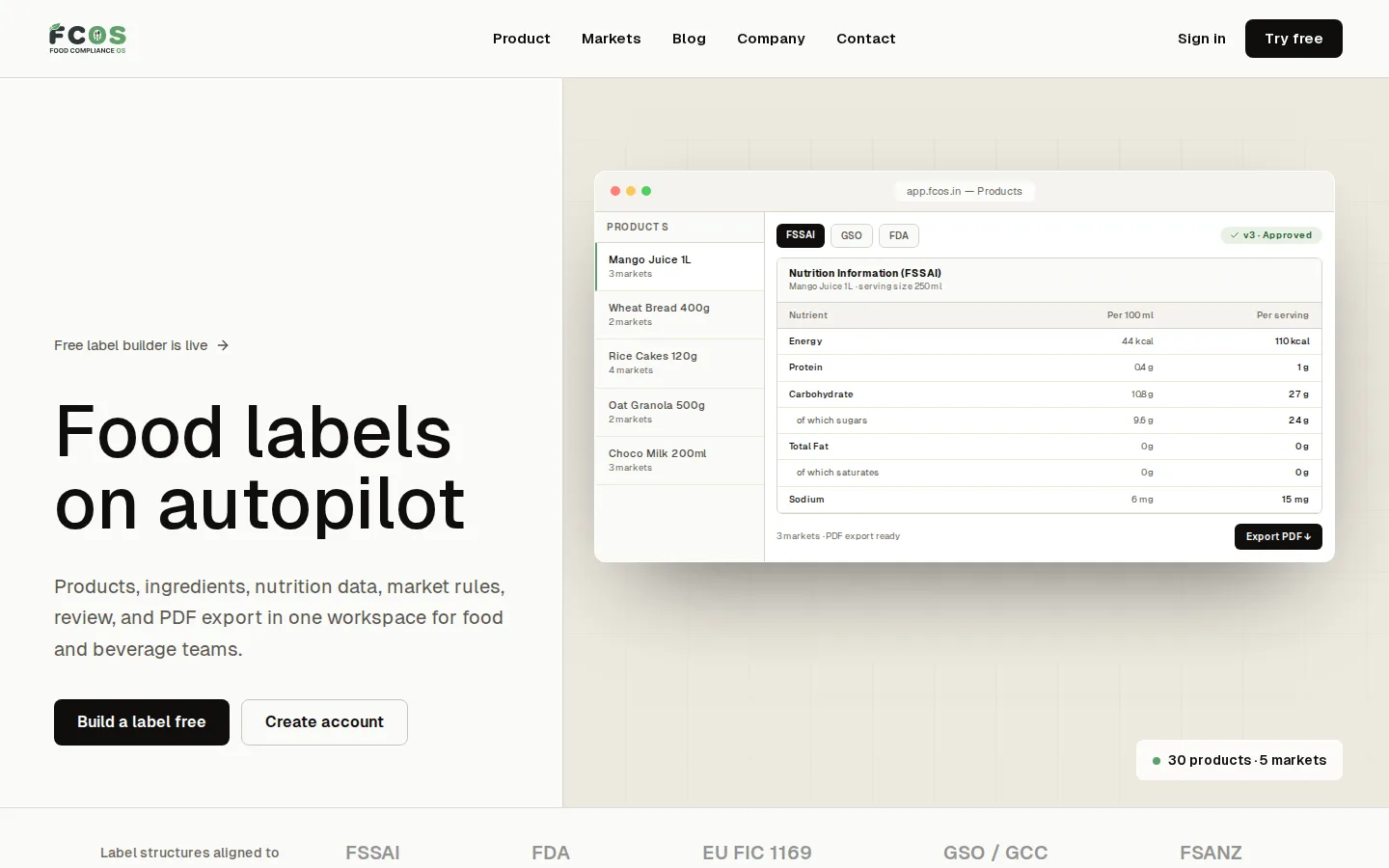
Establish a single source of truth for all stakeholders within this system. When you change a formulation or add a new ingredient, update the central repository. The software then reflects this change across all relevant packaging designs simultaneously because the label templates are linked to the core data. Direct your regulatory teams to review live digital assets rather than static files. This ensures the version under review always contains the most current product information.
Apply rules-based logic within the workflow to handle specific nutrition label requirements by market when operating across different jurisdictions. Use this automation to adjust font sizes, daily value percentages, and allergen declarations to meet local mandates without manual graphic design for every SKU. Shift the focus of your management professionals toward verifying compliance and brand consistency instead of performing repetitive data entry. Implementing this structure synchronizes legal, marketing, and production teams while providing a transparent audit trail of every modification and approval throughout the review cycle.
Centralized data management prevents the 40% of recalls caused by artwork errors
Traditional food labeling processes often rely on disconnected spreadsheets, email threads, and local desktop files. This fragmentation creates a high risk of "data drift," where the nutritional information or ingredient list in a procurement spreadsheet no longer matches the version stored by the regulatory team or the final file used by the graphic designer. When data exists in silos, manual copying and pasting become necessary, introducing human error at every hand-off point.
A digital workflow eliminates these vulnerabilities by establishing a single source of truth (SSOT) for all product specifications. In this model, the master data for nutrition facts, allergen warnings, and ingredient statements resides in a centralized database that feeds directly into the artwork files. When a regulatory professional updates a sodium value or adds a new allergen warning in the central system, the change propagates across all linked label templates automatically. This architectural link ensures that the designer is never working with outdated information and the regulatory team does not need to manually verify every text string during every revision.
The financial and reputational stakes for maintaining this data integrity are significant. Industry data indicates that around 35-40% of product recalls are linked to label and packaging artwork errors. By moving away from manual entry, organizations remove the primary catalyst for these recalls: the discrepancy between approved specifications and the final printed package.
Centralization also enables robust version control. Instead of searching through multiple versions of a spreadsheet titled "Final_V2_Updated," stakeholders access a time-stamped audit trail within the digital workflow. This transparency allows teams to see exactly when data was modified and by whom, ensuring that only the most current, verified data reaches the production stage. This systematic approach transforms label review from a reactive search for typos into a proactive verification of a single, controlled data set.
Automated regional templates replace manual regulatory cross-referencing
Replace manual spreadsheets and PDF markups with logic-based regional templates to initiate a digital food label review cycle. Traditional review processes require a regulatory expert to check every line of text against a printed copy of regional statutes. Modern workflow software automates this by embedding specific market requirements directly into the validation engine. These requirements include standards defined by FSSAI in India, the GCC in the Middle East, or EU 1169/2011 in Europe.
Select a target market within the software to apply a ruleset that governs font sizes, mandatory allergen declarations, and the specific order of the ingredients list. For example, a label destined for the European Union must highlight specific allergens in a way that differs from GCC requirements. Instead of a designer guessing the bolding requirements or a founder cross-referencing a 100-page regulatory PDF, the software flags non-compliant elements in real-time. This logic-driven approach ensures that the master label can be branched into localized versions without recreating the entire data set.
Use this automation to accelerate the timeline for new market entries. By utilizing pre-validated templates, a brand can prepare a product for a new international market without the staff being specialized regulatory experts. The software acts as a first-line compliance filter. It catches common errors, such as incorrect unit measurements or missing "best before" date formats, before the label ever reaches a human reviewer. This reduces the number of revision rounds from dozens to a handful, preventing the bottlenecks that typically occur when a regulatory team is overwhelmed by manual checks.
Adopt these structured digital environments to keep pace with the broader move toward digitized food information. For instance, a systematic review regarding the effects of digitalized front-of-package food labels was received on 2022 Jul 24, indicating the increasing relevance of digital-first approaches in consumer transparency and regulatory compliance.
Map your product specifications to the template fields to implement this system. Once the data is centralized, the software generates the layout based on the rules of the selected jurisdiction. This ensures that the technical specifications of the food product, such as sodium content or caloric density, are automatically formatted to meet the specific rounding rules and layout constraints of the target region. This systematic application of logic eliminates the accidental oversight that often leads to costly product recalls or customs delays.
Digital review cycles fail when local physical inspections are mandatory
A digital-only workflow effectively manages internal approvals, but it cannot override the statutory requirements of specific jurisdictions that mandate physical submissions or manual state-level inspections. Project managers must identify these regulatory bottlenecks early to prevent the digital workflow from stalling at the final stage of compliance.

In California, for example, the California Department of Food and Agriculture (CDFA) maintains strict oversight of milk and dairy food safety. Under Section 32912.5 of the California Food and Agriculture Code, sample copies of all labels must be submitted for approval. While digital systems handle the design and internal verification, the legal requirement for a state-level filing remains a manual hurdle. If a manufacturer is unable to submit an electronic image for this process, they must provide three color copies of the label to the department.
These manual reviews introduce significant costs that must be accounted for in the product development budget. The state applies a label review charge of $154.77 per hour to process these submissions. Stakeholders should verify the current California Department of Food and Agriculture fee schedule on the agency’s website, as these rates are subject to change and can significantly impact the total cost of bringing a product to the California market.
To integrate these edge cases into a digital workflow, teams must treat the physical submission as a hard stop in the project timeline. The workflow should trigger a notification to the regulatory affairs department once the digital design is finalized, prompting the dispatch of physical samples or the initiation of the manual state review. Relying solely on a digital "pass" for these jurisdictions results in non-compliant packaging entering the supply chain, regardless of how accurate the internal digital review was. By acknowledging where the digital thread ends and physical bureaucracy begins, organizations can accurately forecast launch dates and avoid the financial penalties associated with unapproved labeling.
Audit trails establish accountability across multi-market product teams
Use a centralized B2B workspace to store all food label assets in one location. This replaces fragmented email chains and local server folders. To maintain accountability, administrators must configure granular user permissions that reflect the specific responsibilities of the regulatory, design, and marketing departments. Assign roles, such as "Editor" for graphic designers and "Approver" for compliance officers, so the system prevents unauthorized changes to critical label elements like allergen declarations or ingredient lists.
In a multi-market environment, these permissions allow regional teams to access only the stock-keeping units (SKUs) relevant to their territory. This isolation reduces the risk of a user inadvertently modifying a label intended for a different regulatory jurisdiction. When a label moves through the review cycle, the workspace tracks every interaction to create a chronological log of edits, comments, and status changes. This log functions as a permanent audit trail, identifying exactly who modified a specific text block and when the change occurred.
Version control within a digital workflow eliminates the risk of sending the wrong file to print. Instead of relying on manual file naming conventions, the system assigns a unique version number to each iteration of a label. When a compliance officer reviews a file, they are approving a specific digital instance of that asset. The workflow software locks the file against further edits once the final sign-off is recorded.
This locking mechanism ensures that the PDF exported for the printer is identical to the one vetted by the legal team. If a designer attempts to adjust a layout after the compliance sign-off, the system forces the creation of a new version, which automatically resets the approval status. This hierarchy prevents the "final_v2_revised" naming errors common in manual workflows. By requiring a formal digital signature for each market-specific label, the platform ensures that accountability is documented and that only the verified, compliance-cleared version can reach the production stage. Before committing to a specific workflow platform, users should verify the specific user-seat limits and permission tiers on the vendor’s current pricing page, as these parameters vary by subscription level.
Compare cloud-based compliance tools against traditional manual methods
Food manufacturers typically begin their labeling journeys using general-purpose office software. Spreadsheets and email threads serve as the foundational infrastructure for tracking ingredient statements, allergen declarations, and nutritional facts panels. While these tools are accessible, they rely entirely on the manual vigilance of the user. In a manual environment, a digital workflow for food label review cycles consists of fragmented files stored in disparate folders, where the "final" version is often indistinguishable from previous iterations.
The transition to a dedicated Food Compliance Operating System (FCOS) becomes necessary when the complexity of regional regulations outpaces the capacity of manual oversight. When a team manages multiple stock keeping units (SKUs) across different jurisdictions, the risk of a labeling error increases. Manual methods lack the proactive guardrails required to prevent a non-compliant label from reaching the printer. A digital workflow replaces passive storage with active validation, ensuring that every stakeholder views the same data in real-time.
| Feature | Manual Spreadsheet Workflow | FCOS Digital Workflow |
|---|---|---|
| Data Integrity | High risk of manual entry errors and version conflicts across local files. | Single source of truth with automated validation and centralized data entry. |
| Regional Compliance Logic | Dependent on the manual research and memory of individual regulatory specialists. | Built-in regulatory rulesets that automatically flag inconsistencies for specific markets. |
| Review Speed | Sequential and slow; relies on email attachments and manual follow-ups. | Parallel reviews with real-time status tracking and automated notifications. |
| Audit Readiness | Requires manual reconstruction of history through archived emails and old file versions. | Instant access to full version histories, timestamped approvals, and change logs. |
For organizations currently struggling with version control or missed deadlines, evaluating these differences helps identify the point of diminishing returns for spreadsheets. Professionals who find themselves spending more time reconciling email threads than verifying nutritional data should consider migrating to a centralized platform. Those who already have access to such a system but have lost track of their credentials can Reset your FCOS password to regain access to these automated features. Moving to a digital workflow is less about replacing staff and more about providing them with a framework that eliminates the administrative friction inherent in manual compliance checks.
The 'Free Experience' model validates label accuracy before account commitment
Use the 'Free Experience' feature to bypass procurement delays and verify software performance before committing to a full account. Product teams can test the engine's ability to handle complex ingredients immediately, which avoids the uncertainty often found in lengthy onboarding cycles. Generate and preview labels using the FCOS tool to see how the system processes your data without signing up first.
Input raw product data, including ingredient lists, weights, and allergen profiles, into the tool to generate an immediate rendering of a compliant label. Compare this generated preview against your manual records to verify the engine's logic. This step allows you to observe how the system applies nutritional rounding, allergen highlighting, and font scaling in real-time. Confirm that the digital output meets the regulatory demands of your specific product categories before you migrate your database.
Use this entry point as a proof-of-concept for your broader digital workflow. You can eliminate the risk of adopting a system that cannot handle niche requirements, like multi-component ingredients or country-of-origin claims, by testing them now. Once you validate the accuracy of the preview, Create your FCOS company account to save these drafts, manage multiple SKUs, and invite collaborators into the formal review chain. Check the current pricing page for specific features and volume limits after your initial no-cost preview, as subscription tiers are subject to updates. This model ensures you base your decision to digitize on technical performance rather than marketing promises.
Standardize bakery and specialty product labels through market-specific builders
Deploy category-specific builders to lock in regulatory requirements before the design phase begins. This creates a digital workflow for food label review cycles. In the bakery and specialty food sector, labels must account for complex variables like characterizing ingredients, processing aids, and specific allergen cross-contamination warnings. Configure your digital workspace to apply automated rule sets based on the product’s final retail destination rather than relying on manual checklists.
Use a digital builder as a structured data entry environment where the software validates inputs against pre-defined market standards. For bakery products, ensure the builder calculates moisture loss during baking and the subsequent impact on the final weight declaration and ingredient order. By integrating these calculations directly into the workflow, the system flags discrepancies in real-time. This prevents bottlenecks where a label reaches the final legal review only to be rejected for a fundamental rounding error or an incorrect QUID (Quantitative Ingredient Declaration) percentage.
Follow a clear sequence of operations to manage the complexity of specialty products. First, capture the raw recipe data. Next, apply the specific regional labeling logic. This logic covers distinct naming conventions for fats and specific font size requirements for allergens in different jurisdictions. For a detailed breakdown of the technical milestones required for these products, refer to this Bakery Product Nutrition Labeling Guide: A Compliance roadmap to align your digital workspace with current industry standards.
Route the file through a centralized review cycle once the builder generates the technical draft. This stage ensures that marketing claims, such as "high fiber" or "artisan," are cross-referenced with the actual nutritional output generated by the system. Standardizing these inputs within a market-specific builder shifts the review cycle from a search for basic errors to a high-level verification of brand and regulatory alignment. This structure reduces revision rounds and keeps the specialty product roadmap on schedule for retail launch.
Scale global distribution by centralizing GCC and UAE label requirements
Centralize Gulf Cooperation Council (GCC) and UAE label requirements within a single digital environment to manage GSO (GCC Standardization Organization) standards effectively. Move beyond simple translation by housing regional templates alongside European or North American assets. This centralization eliminates the silo effect caused by managing Middle Eastern labels through disparate regional offices or third-party agencies using disconnected software.
Manage mandatory bilingual presentations by using digital workflows that support Right-to-Left (RTL) Arabic text blocks alongside Left-to-Right (LTR) English layouts. This single-workspace approach ensures that mandatory elements are applied consistently across the entire product line. These elements include the country of origin, production and expiration dates in the prescribed DD/MM/YYYY format, and specific ingredient warnings. Centralizing these assets allows the system to flag changes in a global ingredient deck for the Arabic translation team immediately, which prevents version drift.
Integrate specific UAE mandates into your primary digital workflow to avoid the version control failures associated with disconnected files. While GSO standards provide a regional baseline, the UAE frequently implements unique circulars regarding nutritional panels and front-of-pack claims. Use a single source of truth to reduce the risk of rejection at the port of entry. Teams should reference a UAE Nutrition Label Requirements + Label Builder Guide to verify technical specifications for mandatory fortification or layout requirements before starting the formal review cycle.
Scale your operations by utilizing dynamic fields and automated triggers within the workflow. Configure the system to populate bilingual templates and assign tasks to GSO 9/2013 specialists automatically when a SKU is designated for the GCC or UAE market. This approach allows the QA team to verify that Arabic terminology for sensitive ingredients, including animal fats or stabilizers, matches the approved regulatory database. Treat GCC requirements as a core component of the global digital workflow to reduce cycle times for regional launches and minimize labeling errors that cause customs delays.
Choose Between Manual Oversight or Automated Compliance
The transition to a digital workflow requires a clear assessment of your current infrastructure and global expansion goals. Before selecting a platform to manage your food label review cycles, execute the following evaluation process:

- Audit recall history, identifying if artwork errors or data silos contributed to previous market withdrawals.
- Evaluate regional complexity, determining if your current team can manage divergent GCC and UAE regulations without automated cross-referencing.
- Assess inspection requirements, verifying if your target markets mandate physical label samples that would bypass a purely digital approval cycle.
- Quantify stakeholder touchpoints, mapping the number of manual hand-offs required to move a label from raw data to final print.
- Test system interoperability, confirming if a cloud-based tool can ingest your existing bakery or specialty product data without manual re-entry.
FCOS provides a Free Experience model that allows you to validate label accuracy against global standards before committing to a full account. Visit FCOS to run your first automated compliance check and secure your global supply chain.