- fssai
- nutrition-labels
- exports
- food labelling
- compliance
How to Meet EU Allergen Bolding Requirements in Ingredient Lists
A step-by-step guide to EU 1169/2011 compliance for allergen bolding, font sizes, and ingredient list formatting for B2B food and beverage brands.
FCOS Team18 min read
Manual formatting of ingredient lists is the primary cause of regulatory rejection for food exports entering the European Union. While a designer might prioritize the aesthetic flow of a back-of-pack label, EU Regulation 1169/2011 mandates specific typographic treatments that frequently conflict with brand style guides. If you are a solo producer preparing your first shipment, the risk of ignoring these rules is a costly relabeling exercise at the border. If you are a compliance officer at an agency managing hundreds of SKUs for international clients, the risk is a systemic failure that triggers a product withdrawal across multiple member states.
Achieving a shelf-ready, EU-compliant ingredient list requires a precise sequence of data auditing and physical measurement. You must have your full recipe, final packaging dimensions, and a comprehensive understanding of the 14 regulated allergens before you begin the layout process. This guide settles the technical requirements for eu allergen bolding requirements in ingredient lists, moving from the identification of trigger substances to the exact x-height specifications required for different pack sizes. By following this workflow, you can ensure that every allergen is emphasized correctly within the list—rather than in a separate, non-compliant allergen box—while maintaining the legibility standards required for legal sale.
Key takeaways
- Identify all 14 mandatory EU allergens within your ingredient list for specific visual emphasis.
- Use distinct typography—not just bolding—to ensure allergens stand out from the rest of the text.
- Maintain a minimum x-height of 1.2mm for all mandatory information to ensure legal legibility.
- Centralize multi-market data to prevent formatting errors when switching between EU and FDA or GCC standards.
Table of contents
- Mastering EU Allergen Bolding and Formatting Standards
- Audit Your Recipe Against the 14 Regulated EU Allergens
- Apply Visual Emphasis to Specific Allergenic Terms
- Calibrate Font Sizes for Packaging Surface Area
- Calculate Thresholds for Sulphites and Alcohol Content
- Centralize Compliance Data for Multi-Market Export
- Verify Trace Labelling Against Voluntary Thresholds
- Automate the Transition from Data to Compliant PDF
- Avoid Common Bolding Failures that Delay Launch
- Frequently asked questions
- Choose Between Manual Validation and Automated Label Generation
Mastering EU Allergen Bolding and Formatting Standards
The objective of formatting an ingredient list according to EU standards is to produce a shelf-ready label that ensures consumer safety and regulatory compliance. Under Regulation (EU) No 1169/2011, also known as the Food Information to Consumers (FIC) regulation, allergens must be clearly distinguishable from the rest of the ingredients. Achieving this requires a systematic approach to typography and layout that leaves no room for ambiguity.
Before beginning the formatting process, three components must be finalized. First, obtain a complete and precise recipe. This list must include every component, including sub-ingredients of compound ingredients, carriers for additives, and processing aids that may still be present in the finished product. Second, determine the exact dimensions of the packaging. EU law mandates specific minimum font sizes based on the "largest surface area" of the pack; for instance, an x-height of at least 1.2 mm is generally required, though this reduces to 0.9 mm for smaller packaging. Third, maintain a definitive reference of the 14 regulated allergens. Only these specific substances and their derivatives require mandatory emphasis.
Formatting is not merely a design choice but a legal requirement to assist the visually impaired and allergic consumers. The goal is to create high contrast and immediate legibility. By securing the recipe, packaging specs, and allergen list beforehand, a professional can ensure the final label avoids the costly errors associated with product recalls or forced relabeling by market authorities.
Audit Your Recipe Against the 14 Regulated EU Allergens
Compliance begins with a comprehensive review of every component within a product formulation to identify substances that pose a risk to sensitive consumers. Under EU Regulation No. 1169/2011, information regarding 14 specific allergens must be provided in written form for all prepacked foods. This requirement stems from a directive for common allergy triggers that has regulated the labeling of the 14 most frequent causes of allergies and intolerances since 13 December 2014.
The first step for any food business is to audit their recipes against the official list of regulated substances:
- Cereals containing gluten (such as wheat, rye, barley, and oats)
- Crustaceans
- Eggs
- Fish
- Peanuts
- Soybeans
- Milk (including lactose)
- Nuts (such as almonds, hazelnuts, walnuts, cashews, pecans, Brazils, pistachios, and macadamias)
- Celery
- Mustard
- Sesame seeds
- Sulphur dioxide and sulphites (at concentrations of more than 10mg/kg or 10mg/litre)
- Lupin
- Molluscs
This audit must extend beyond primary ingredients. These triggers require mandatory declaration whenever they are used in the manufacture or preparation of a food and are still present in the finished product, even in an altered form. This includes use as processing aids, carriers for flavors, or components of complex food additives.
To ensure accuracy, examine the technical data sheets provided by every raw material supplier. If a sub-ingredient or processing aid is derived from one of these 14 sources, it must be flagged during this initial audit phase. Failure to identify a derivative, such as a soy-based emulsifier or a milk-derived casing, will result in an incomplete ingredient list that violates EU transparency standards. Once every instance of these 14 substances is identified within the recipe, the focus shifts to how these terms are presented to the consumer.
Apply Visual Emphasis to Specific Allergenic Terms
Distinguish every ingredient or processing aid derived from Annex II substances from the rest of the ingredient list to comply with European labeling standards. Use a specific typeset, such as a different font, style, or background color, to meet the requirements of Regulation (EU) No 1169/2011. Bolding is the most effective and common method to achieve this mandatory visual contrast.
Apply the emphasis directly to the specific allergenic substance within the ingredient name. In a bakery product list, for example, the text should read "wheat flour" or "skimmed milk powder." When the ingredient name clearly refers to the allergen, such as "milk" or "eggs," you must highlight the term itself. For multi-word ingredients like "soy lecithin," you must bold the allergenic component "soy," though bolding the entire term "soy lecithin" is also acceptable if the allergen remains prominent.
Do not rely on a separate "allergen box" (e.g., "Contains: Milk, Eggs") as a substitute for bolding within the ingredient list. The European Union requires the primary allergen communication to occur within the list of ingredients. You may provide a supplemental box, but it does not fulfill the legal requirement on its own. Use the European Commission’s 2013 allergen labeling Q&A to guide the technical implementation of these distinctions on physical packaging.
Highlight every individual instance of an allergen when a product contains several ingredients derived from the same source. If a recipe includes both milk and lactose, emphasize both terms because they both originate from the same allergenic source. This ensures that consumers scanning the list can immediately identify all substances that may trigger an adverse reaction without reading the entire panel in detail.
Calibrate Font Sizes for Packaging Surface Area
Measure the physical scale of your packaging to ensure allergen bolding meets EU legibility standards. The visual emphasis applied to allergenic substances, whether through bolding, contrasting colors, or underlining, is only effective if the underlying text meets strict legibility standards defined by EU law.
Set your font so the x-height, which is the height of the lowercase letter "x," meets the 1.2-millimetre minimum required by general EU food labelling rules. This rule applies to all mandatory information, including the ingredients list where you highlight allergens. When you select a typeface, confirm that the bold weight does not compress the x-height or distort characters, as this can reduce legibility below the legal threshold.
Reduce the x-height to 0.9 millimetres only if the largest surface area of your packaging is less than 80 cm². This minimum x-height for mandatory information allows for the inclusion of all required data on small containers, such as the alcohol level for beverages exceeding 1.2% by volume.
Maintain sharp contrast between the allergen and the surrounding text when using the 0.9 mm allowance. Test your packaging proofs to prevent "ink spread," a printing issue where the holes in letters like 'e' or 'a' fill in and make words unreadable. If bolding causes letters to bleed together, switch to a different typeface or use a more pronounced color contrast to maintain compliance. Always perform the final x-height measurement on the actual printed substrate, because different materials can change the clarity of the typeface.
Calculate Thresholds for Sulphites and Alcohol Content
EU food labeling regulations distinguish between allergens that require declaration regardless of quantity and those that trigger specific labeling requirements only after reaching a quantitative limit. While most of the 14 major allergens must be highlighted whenever they are present, sulphur dioxide, sulphites, and alcohol content are governed by specific concentration triggers. Bolding or explicit declaration only applies if these measured levels are met or exceeded.
For sulphur dioxide and sulphites, the requirement for declaration and highlighting depends on the total concentration in the finished product, calculated as total $SO_2$. According to ECARF food labeling requirements, these substances must be labeled if they are present in concentrations of more than 10 mg/kg in solid foods. For liquid products, the same source specifies that the threshold for mandatory labeling is 10 mg/l. If the concentration is below these figures, the manufacturer is not required to bold the ingredient, as the risk to sensitive individuals is considered lower at these trace levels.
Beverage manufacturers must also monitor alcohol concentration to ensure regulatory compliance. General EU food labeling rules state that the alcohol level for beverages must be shown if the concentration is higher than 1.2% by volume. Unlike standard allergens, which are highlighted within the ingredient list, this alcohol content must be clearly displayed to inform the consumer of the beverage's potency.
| Substance | Mandatory Threshold | Labeling Requirement |
|---|---|---|
| Sulphur dioxide/sulphites (Solid) | More than 10 mg/kg | Must be declared and highlighted in the ingredient list. |
| Sulphur dioxide/sulphites (Liquid) | More than 10 mg/l | Must be declared and highlighted in the ingredient list. |
| Alcohol in beverages | Higher than 1.2% | The actual alcoholic strength by volume must be displayed. |
Verification of these levels through laboratory analysis or strict recipe calculation is necessary before finalizing packaging artwork. Because formulations and raw material specifications can change, manufacturers should confirm current regulatory thresholds and vendor-specific concentrations on their respective official documentation pages to ensure ongoing accuracy. Bolding these substances when they fall below the legal threshold is not required and may lead to consumer confusion regarding the actual composition of the product.
Centralize Compliance Data for Multi-Market Export
Use a centralized system to manage eu allergen bolding requirements in ingredient lists when exporting to multiple international markets. EU Regulation 1169/2011 requires 14 specific allergens to be emphasized through typography, which is typically bolding. Other jurisdictions, such as the United States or Australia, use different identification and formatting standards. Stop using separate manual spreadsheets for each regional label iteration to avoid human error and version control failures.
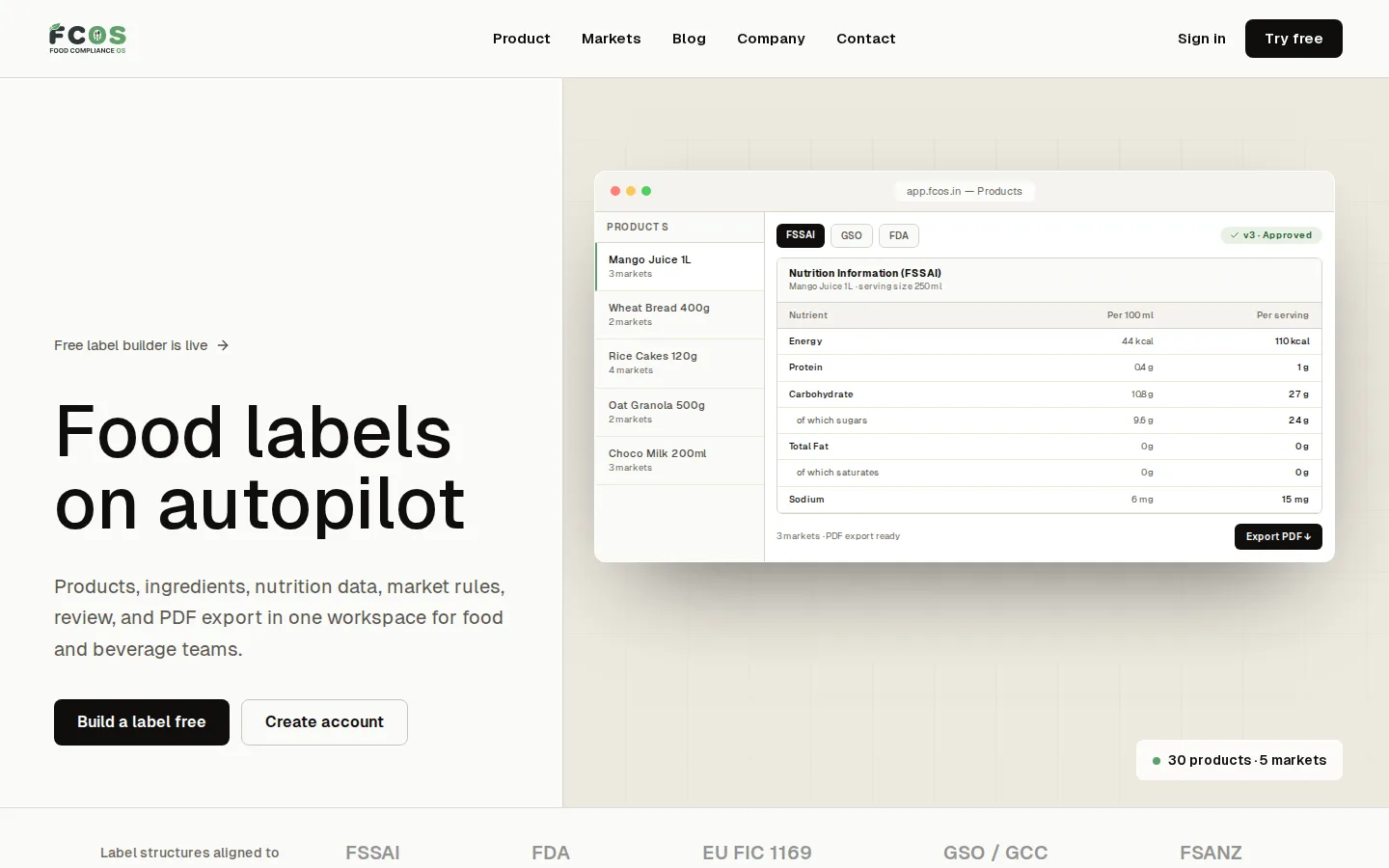
Move regulatory data from static documents into a centralized digital workspace. A platform like FCOS serves as a unified database where all raw material specifications are stored and synchronized. Map specific components to their regulatory triggers within this one location. The system applies formatting based on predefined regional rules, removing the need to manually bold "Wheat" or "Milk" for every European market label.
Toggle between EU 1169/2011 standards and other global requirements without re-formatting the entire ingredient list. When you select the EU as the destination, the software identifies the 14 mandatory allergens in the recipe and applies the required emphasis. If you export the same product to a region with different allergen rules, switch the compliance profile. The system adjusts the text to meet that region's legal definitions, highlighting or declaring only the relevant substances.
Ensure all team members maintain active access to the platform to meet export deadlines. If you are locked out during a labeling cycle, Reset your FCOS password to restore access to these automated tools.
Update the central workspace to respond quickly to regulatory changes. If the EU expands the mandatory allergen list or changes the emphasis method, one update applies to all relevant product labels. This removes the requirement to audit every SKU manually. The entire catalog stays compliant with the latest eu allergen bolding requirements in ingredient lists at the same time. Review the vendor’s pricing page for current plan details and features, as these details are updated periodically.
Verify Trace Labelling Against Voluntary Thresholds
While EU Regulation 1169/2011 mandates the bolding of the 14 major allergens within the ingredient list, it does not strictly regulate "May Contain" statements, also known as Precautionary Allergen Labelling (PAL). These trace declarations remain voluntary. However, to maintain consistency with eu allergen bolding requirements in ingredient lists, manufacturers must ensure that voluntary statements do not mislead the consumer or obscure mandatory information.
To decide whether a trace declaration is necessary, brands should move away from qualitative "just in case" labelling and toward quantitative risk assessments. A GA²LEN Network position paper proposes a threshold of 0.5 mg of protein per 100 grams of processed food for voluntary trace labelling. This figure serves as a scientific benchmark; if the unintended presence of an allergen is verified to be below this concentration, the risk of a reaction for the vast majority of the allergic population is significantly reduced, and a "May Contain" statement may be omitted.
Implementing these thresholds requires a rigorous audit of the production environment. Operations teams should calculate the potential protein carryover from shared equipment or raw material suppliers. If the data shows that cross-contact levels exceed the 0.5 mg per 100g threshold, the voluntary statement should be included to protect the consumer. By using these specific metrics, brands can avoid over-labelling, which often leads to "label fatigue" where consumers begin to ignore warnings.
Ensuring that voluntary trace declarations are backed by data prevents the cluttering of the packaging. This allows the bolded ingredients in the mandatory list to stand out clearly, fulfilling the primary intent of the EU regulations. Review the specific allergen management protocols for each facility to ensure data accuracy before finalizing the label artwork.
Automate the Transition from Data to Compliant PDF
Eliminate manual formatting to transition raw ingredient data into print-ready, compliant PDFs. Manually identifying and bolding allergens within a long ingredient string is a high-risk activity. Missing a single instance of "whey" or "soya" can lead to rejected shipments or costly product recalls. To accelerate the timeline from formulation to market, use label builders that automate the application of Annex II requirements.
Input the full ingredient list into a centralized specification system. Instead of manually applying rich text formatting to individual words, select "Europe" or "EU" as the target market within the software settings. This selection triggers an underlying logic engine programmed to recognize the 14 specific allergens. These substances include cereals containing gluten, crustaceans, eggs, fish, peanuts, soybeans, milk, nuts, celery, mustard, sesame seeds, sulphur dioxide and sulphites, lupin, and molluscs.
Set the market to allow the system to scan the text for these substances and their derivatives, which automatically applies the required bold typeface. This automation ensures that the formatting remains consistent across the entire product line, regardless of how many different languages or regional variations the label requires. For professionals managing global portfolios who need to understand how these automated systems handle different regional standards, this UAE Nutrition Label Requirements + Label Builder Guide provides a detailed comparison of market-specific logic.
Generate a high-resolution PDF that complies with the legibility and emphasis standards of EU No. 1169/2011. Using an automated builder reduces the time spent on manual proofreading and formatting from hours to seconds. Because the bolding is tied to the market setting rather than manual text styling, the risk of human oversight is significantly lowered, allowing products to move through the regulatory approval phase and into production at a much higher velocity. Check the specific features and pricing of any label builder software on the vendor's current pricing page to ensure the chosen plan supports automated EU allergen logic, as capabilities and subscription tiers are subject to change.
Avoid Common Bolding Failures that Delay Launch
Highlight allergens directly within the ingredient list using distinct typography, such as bolding, contrasting colors, or italics. Do not use a separate "Contains" box as a substitute for in-list bolding. While you may include a voluntary summary box, the European Parliament and European Council implemented updates to food safety and allergen labeling on 13 December 2016, which mandates emphasis within the list itself. This regulatory framework replaced seven existing directives and remains the standard for EU compliance.
Verify font sizes during the design phase to meet specific x-height requirements. Set the x-height to at least 1.2 mm for most packaging. If the largest surface area of the pack is less than 80 cm², you may reduce the x-height to 0.9 mm. Labels that fail these measurements will be rejected during quality assurance audits, even if the allergens are correctly bolded.
Update bolding immediately whenever a supplier changes an ingredient. For example, if a supplier swaps a standard thickening agent for one derived from wheat, the new allergen must be highlighted. Neglecting to synchronize the label with the current recipe violates EU 1169/2011 and risks consumer safety. For professionals managing these transitions across different markets, understanding the structural differences between global label types is critical. Refer to this Supplement Facts vs Nutrition Facts: The Compliance Guide for a deeper look at formatting standards. Failure to maintain these updates creates a direct violation of safety standards and threatens brand reputation.
Frequently asked questions
What are the legal requirements for food allergen labeling in the EU?
EU Regulation No. 1169/2011, also known as the Food Information to Consumers (FIC) regulation, mandates that allergens must be highlighted in the ingredient list using a distinct typeset. This visual differentiation is typically achieved through bolding, but can also include contrasting background colors or italics to ensure the substances are easily identifiable. The requirement applies to all prepacked foods sold within the European Union, including those imported from third countries.
Does the EU require all ingredients to be listed?
Regulation requires that all ingredients be listed in descending order of weight as they were recorded at the time of manufacturing. While specific exemptions exist for items like fresh whole fruit or carbonated water, any substance derived from the 14 regulated allergens must be declared regardless of the food category. Even processing aids or carriers that are not technically ingredients but are derived from these 14 substances must be clearly labeled and emphasized.
How many allergens must be listed in the ingredients list?
There are 14 specific allergens that must be explicitly named and emphasized whenever they are present in a food product. These include cereals containing gluten, crustaceans, eggs, fish, peanuts, soybeans, milk, nuts, celery, mustard, sesame seeds, sulphur dioxide and sulphites at specific concentrations, lupin, and molluscs. If an ingredient name already clearly refers to the allergen, such as "milk," only that specific term requires bolding.
Are companies required to list allergens on their ingredient lists?
Companies must legally declare every regulated allergen used in the production of prepacked food directly within the ingredient list. For non-prepacked foods, such as those sold in restaurants or delis, allergen information must still be accessible to the consumer, though the specific delivery method may be governed by individual Member State national laws. Accurate labeling is a mandatory safety requirement, and failure to apply the correct formatting can lead to immediate product withdrawals from the EU market.
Choose Between Manual Validation and Automated Label Generation
Before finalizing your approach to EU allergen bolding requirements in ingredient lists, you must determine whether your current workflow can sustain the precision required by Regulation (EU) No 1169/2011. Answer these five questions to decide if your manual processes are sufficient or if you require a digital solution:
- Audit your SKU volume, determining if the number of active labels allows for a line-by-line manual check of every allergenic term.
- Assess linguistic expertise, evaluating whether your team can accurately identify and bold all 14 regulated allergens and their derivatives across every language used on your multi-market packaging.
- Map data transitions, identifying the specific points where ingredient data moves from the supplier specification to the graphic designer to ensure no bolding is lost during formatting.
- Quantify regulatory risk, calculating the potential cost of a market withdrawal or relabeling project should a single allergen derivative miss the required visual emphasis.
- Review update frequency, establishing how often recipe changes or supplier substitutions occur and how quickly those changes must be reflected in your print-ready files.
To eliminate the risk of human error in your ingredient formatting, use FCOS to centralize your compliance data and automate the generation of technical specifications. Book a demo at fcos.cloud to see how the platform applies Annex II bolding rules to your labels instantly.